Buyers used to pay for markets and licences. Now they pay for LTV and brand equity.
Scale and a licence used to set the price. Now the diligence is about whether the brand and the customers survive the integration. Gaming M&A is busy again in 2026, and the question buyers ask before they pay has changed. This week Kambi signed two multi-year deals, one with Pure Casino in Alberta and one with RETABET in Spain and Peru. Alberta reached 24 live operators just ten days after opening. What deal-makers now say out loud is simple: a licence and a market are no longer enough to set the price.
Why do casino operators pay national apps to reach players already sitting in their own database?
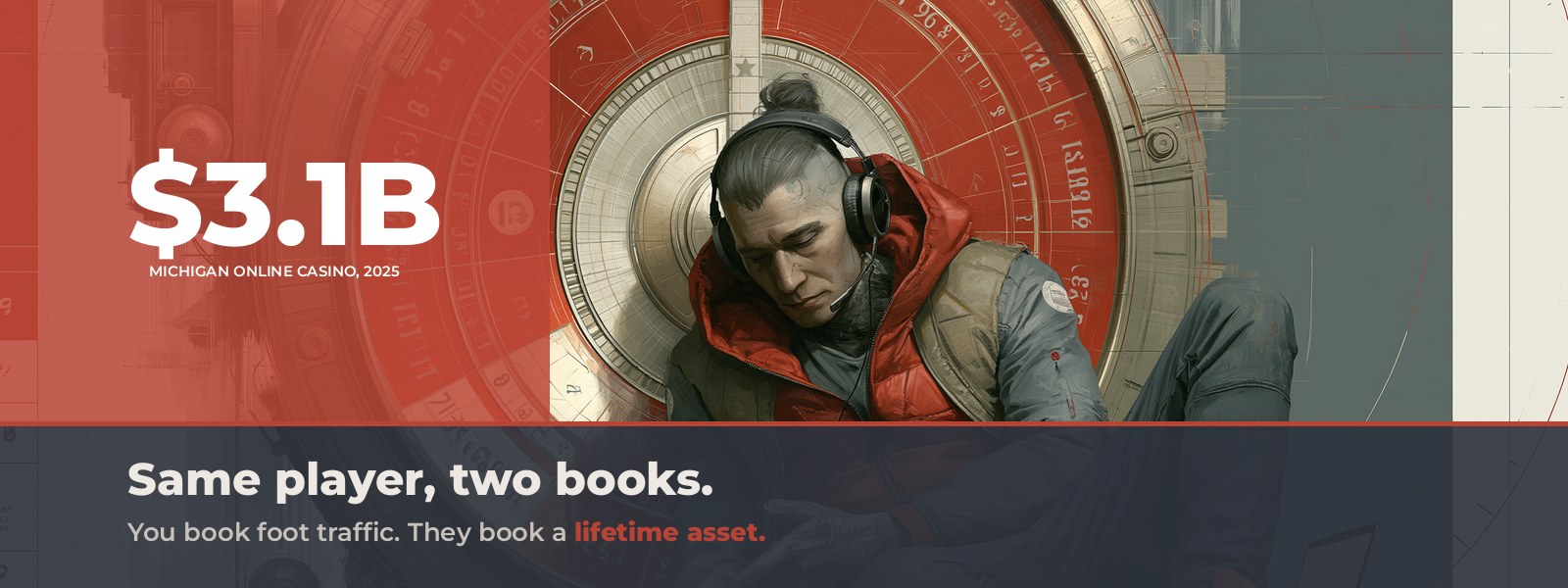
Regional and tribal operators built the brand, the loyalty file and the floor traffic the national apps pay heavily to rent. The player they already own keeps paying someone else once they get home. Michigan is the second-biggest online casino market in the US. It brought in $3.1B in 2025, up 29.5%. About 88% of that goes to five national apps: BetMGM, DraftKings, FanDuel, Caesars and Golden Nugget. Around ten local and tribal operators split what is left. Those locals have what no app can buy: a known name, their own player lists, loyalty data, VIP relationships, and people walking through the door every week. In October 2025 one Michigan tribal operator linked its floor loyalty programme so points earn and spend across both the casino and the app. A player you reach on the floor and the app is worth about a third more, and you already own them.
Why is private capital buying the thing you book as overhead?

Three moves in one month repriced regulated trust: a private-equity rollup, an Ohio mandate, and $50B cleared without it. The spend you file as overhead is the asset in play. Read three stories from one week as a single move. Visualize Group agreed to buy eCOGRA on 30 June, its second deal for a testing house after BMM Testlabs. Ohio moved to make a voluntary credit-card rule official, one most operators already follow. And prediction markets cleared $50B on the World Cup while carrying none of the player protection that licensed operators spent a decade building.
Who is quietly buying the infrastructure that certifies this industry is fair?
Two of gaming’s recognised testing houses now sit under one owner. Private capital is treating trust as a business while operators file it as overhead. Two of gaming’s best-known testing houses now sit under one owner. Visualize Group bought eCOGRA, the London testing and certification firm, its second such deal after BMM Testlabs. The same pattern runs across the trust business. Corsair Capital took a majority of the ID-check firm IDnow at $295M. Sumsub passed a $1B valuation in January 2026. And a new EU agency, AMLA, took over anti-money-laundering rules across Europe on 1 January 2026, raising the bar everyone has to clear.
Read the signal →
Prediction markets took $50B on the World Cup. Your licence is the edge they cannot buy.
Event contracts won the volume argument at record scale. The consumer-protection argument is still unclaimed. Prediction-market sites took more than $50B in bets across the World Cup opening. Kalshi handled $31B in June, about 85% on sports. Polymarket’s international site set a record $10.8B, plus $3.5B on its US site. The World Cup Winner market alone drew about $3.9B on Polymarket and $800M+ on Kalshi. Both are regulated by the CFTC and legal in all 50 states on paper. Massachusetts bans sports event contracts, and Arizona, Michigan, Nevada and California are fighting them in court.
Evolution kept its margins and still got marked down. The story slipped.
Reported revenue fell 1.2%. At constant currency it grew 2.4%, and the Galaxy deal is now in doubt. Evolution reported Q2 2026 revenue of €517.8M, down 1.2% on last year as reported but up 2.4% once you strip out currency swings, just short of the €520M the market expected. Profit (EBITDA) was €341.0M, a 65.9% margin. Its planned Galaxy Gaming purchase, already delayed to 17 July 2026, is now in doubt. Growth in the Americas keeps making up for a soft Europe.
Read the signal →
A top-ten supplier rebranded to charge more. Now it has to make it stick.
SOFTSWISS moved from software provider to growth partner on 1 July. The claim is made. Whether operators pay for it is a different question. SOFTSWISS changed its pitch and its look on 1 July 2026. It went from calling itself a software provider to a growth partner, and gave someone the title of Chief AI Officer so reliability and AI move together. It showed the new identity to partners in person at iGB L!VE London on 6 July, an event built around operators wanting suppliers to add performance rather than just supply a service.
Read the signal →
Ohio is about to erase a head start most operators never claimed.
Most Ohio sportsbooks already dropped credit cards on their own. Codification turns that head start into a baseline nobody gets paid for. Ohio’s gaming regulator proposed banning credit cards for funding sports-betting accounts. The comment period closed 17 July, with a vote expected in late summer. It matches a bill called the Save Ohio Sports Act and would put Ohio alongside Illinois and Tennessee. The key fact: most Ohio sportsbooks already stopped taking credit cards on their own, so real pushback is unlikely.
Read the signal →
A famous bear just bought the sportsbooks. Is the story finally too cheap?
Flutter sits 65% below its August peak on a belief about the future, with revenue nowhere near that decline. On 10 July 2026 investor Michael Burry revealed bets on Flutter near $107 and DraftKings in the low $26s, weighted about 60/40 toward Flutter, on the view that regulators will crack down on CFTC event contracts. Flutter trades about 65% below its August high and DraftKings about 45% off its own high. Both are also building their own prediction-market products.
Read the signal →
Safer-gambling AI is becoming law. Vendors still sell it as a cost.
Three jurisdictions moved to mandate real-time risk detection this year. The category still prices to compliance budgets. In early 2026 the UK, the Netherlands and several US states moved to require or strongly push real-time software that spots risky gambling as it happens. The technology already works. The leading system claims it flags at least 87% of the problem cases a human expert would, running in 48+ countries for more than 14.8M players a month. Newer rules also add live affordability checks.
Read the signal →
Alberta went live with 22 of 50 brands. The 28 no-shows are the story.
Province 2 is live at a 20% rate. Twenty-eight approved brands chose to arrive after the preference forms. Alberta opened Canada’s second competitive online-gambling market on 13 July 2026. 22 sites went live at midnight out of 50 that had registered, leaving 28 approved but not launched. Day-one names included FanDuel, DraftKings, bet365, BetMGM and Caesars, against the government-run Play Alberta. Tax is 20% of net revenue. Forecasters expect about CAN$1.2B in gambling revenue this year, rising to CAN$1.64B by 2028.
Read the signal →
Apollo’s IGT still tells three stories. Buyers pay for one.
The $6.3B take-private closed twelve months ago. The combined company still tells three stories, and the exit clock has started. Apollo closed its $6.3B all-cash deal for IGT’s Gaming and Digital business and Everi on 1 July 2025. Everi shareholders were paid $14.25 a share, a 56% premium, and the stock was taken off the market. The combined company now runs privately as IGT, out of Las Vegas, in three parts: Gaming, Digital and FinTech. Hector Fernandez, formerly of Aristocrat Gaming, became CEO in late 2025.
Read the signal →
Same quarter, opposite results: Playtech rose, Evolution fell. Where you sell decided it.
UK duty doubled to 40% in April. Two suppliers in that environment posted opposite results. Playtech’s half-year update on 13 July came in well ahead of expectations, driven by the US plus strength in Mexico, Colombia and parts of Europe. It guided first-half profit above €155M and raised the full-year figure toward €270M. This lands in the same period the UK doubled its online gaming tax from 21% to 40%, on 1 April 2026, hitting about 310 firms.
Read the signal →
Caesars is running three brands in one small market. That is three times the bill.
A blank-slate market where every operator starts at zero recognition on the same day is the cleanest brand-architecture test the industry has run in years. Caesars went live in Alberta on day one, 13 July, with three brands at once: Caesars Sportsbook & Casino, Caesars Palace Online Casino and Horseshoe Online Casino. All three chase the same province of about 4.9M people, from one company, against a field of 50+ registered operators, far fewer of which launched on time.
Read the signal →
Alberta opens tomorrow with 47 operators. Where does the brand-capital land-grab actually sit?
Province 2 goes live 13 July. The projected revenue mix is casino-heavy, which decides which brands compound. Alberta activates its regulated open market on 13 July with 47 registered operators (FanDuel, DraftKings, BetMGM, Caesars, bet365, BetRivers, theScore among them). The province projects $76M Year-1 net revenue; JMP Securities analyst Jordan Bender estimates $700M+ annual at maturity, split roughly $500M iCasino / $200M sportsbook. It is a blank-slate market, no operator holds pre-existing Alberta recognition.
World Cup betting is 9× Qatar. Keeping those players is where the money is made.
US handle is tracking $2.8 to 4.3B, nine times Qatar. Handle is a flow number; the retained cohort is where value is made or lost. US sportsbooks are on track for $2.8B to $4.3B in World Cup bets across 104 matches, about 9× the ~$490M on Qatar 2022. Worldwide betting is projected above $50B (+43%). The 48-team format, legal mobile betting in 39 states and a strong home-team run are pushing volume past plan. Operators have shifted the talk from signing players up to keeping them: game-like features built to hold new bettors past the knockout rounds.
Brazil can now seize illegal betting money, and a top supplier’s name is on the line.
Enforcement climbed from site-blocking to payment liability to fund seizure, and now to supplier integrity. Each rung pushes demand toward the licensed field. A presidential order on 19 June gave Brazil a formal way to freeze and seize the accounts of unlicensed operators. Banks must freeze flagged accounts within 24 hours, with the money sent to a public-security fund. About 37 payment firms are already flagged. At the same time, prosecutors asked to suspend a well-known game supplier until it can prove it does not serve unlicensed operators.
Read the signal →
Prediction markets went mainstream. Whoever owns the word wins the category.
Exchanges borrowed legitimacy from finance and sport, and capital rotated into the rails. The durable contest is the story: market versus gambling. Prediction markets used the World Cup to go mainstream. A big exchange struck a FIFA branding deal and a knockout-stage tie-in, handed out as a free-to-play hub across 23+ US states. Sport is now the main event on both leading sites, over 80% on one and nearly all US activity on the other. Money is pouring into the plumbing too: a $75M raise alongside a CFTC licence, and a $35M fund, backed by the two biggest exchanges’ founders, aimed only at the rails underneath.
Read the signal →
Betr bought its way into prediction markets, and the compliant US entry path became a template.

Betr bought an introducing broker to reach prediction markets. The compliant route is now a purchase, so the advantage moves up into brand and category. Betr bought a registered broker, Ascent Capital Management, to shortcut its way to a CFTC licence and launch Polymarket-powered prediction markets, turning a months-long approval into a purchase. Meanwhile the CFTC’s 10 June draft rule would allow most sports event contracts (final scores, win-loss, season stats) while banning player-prop, injury and referee bets. Prediction markets reportedly passed gambling for the first time at $36.6B in the quarter. Kalshi is teaming up with Nasdaq, Polymarket with Dow Jones.
Alberta’s operator list is shrinking before launch. Is brand discipline now the gate?
The cleared set thinned before the July 13 launch; an established brand sat out and another was removed over a cartoon-branding rule. The AGLC is gating entry on brand and compliance discipline. Ahead of Alberta’s 13 July open-model launch, the registry of operators cleared to go live slipped for the first time. The AGLC has formally cleared 28 operators / 40+ brands pending commercial agreements with the Alberta iGaming Corporation. DraftKings, BetMGM, FanDuel, Betway and Penn’s brands are cleared, but LeoVegas paused new Alberta signups and the AGLC removed one platform over a ban on cartoon-style branding that could appeal to minors.
Read the signal →
Betsson B2B revenue fell 43% in one quarter. What does platform dependency actually cost?

One client departure erased 40% of B2B revenue and halved EBIT margins. Selling on features alone leaves the next renewal entirely in the client’s hands. Betsson Q1 2026: group revenue €285.3M (−3% YoY); B2B revenue −43% on the departure of one major platform client. EBITDA fell from €77.7M to €50M (−36%); EBIT margin collapsed from 21.9% to 11.9% in a single quarter. B2C revenue hit a record high (+15% YoY) in the same period, and LatAm revenue grew 25% to become ∼33% of the group. The company is acquiring Rhino Entertainment Group, a signal of strategic pivot from B2B platform licensing toward B2C control.
The Evolution / Galaxy Gaming deal is taking 18 months, resetting US gaming M&A timelines
18 to 24 months is now the documented duration for a US state-licensed gaming acquisition. Evolution AB’s acquisition of Galaxy Gaming (announced July 2024) has been extended again, current deadline July 17, 2026, pending remaining US state regulatory approvals. Mississippi secured approval in November 2025. The July 17 deadline coincides with Evolution’s Q2 2026 earnings release, creating a binary event: deal closes and earnings land together, or the deadline extends again while results publish independently.
Read the signal →
When the pipes are a commodity, what are operators paying your studio for?
Undifferentiated content prices itself into the commodity tier. The second platform roll-up this quarter consolidates roughly 30% of independent regulated-market aggregation under two owners. Distribution margins compressed again in renewal negotiations, operators report rev-share asks falling 15–20% below last year’s terms, while exclusive-content premiums for named studios widened in the same negotiations. The price signal is unambiguous: pipes are getting cheaper, demand-pull content is getting dearer.
Read the signal →
Leaders are hiring retention over acquisition 3 to 1
Leaders are quietly repricing customer value as the growth engine. Top-quartile operators shifted open roles decisively toward lifecycle and database marketing this quarter: the retention-to-acquisition hiring ratio reached 3.1:1, up from 1.2:1 a year ago. Acquisition-marketing requisitions fell for the second quarter running, while titles that barely existed two years ago, lifecycle architects, CRM data scientists, player-journey designers, now appear across leader job boards. Mid-tier and laggard operators show no equivalent shift.
Read the signal →
Bally’s Intralot to acquire Evoke (William Hill, 888) for £243M
A 138% takeover premium is the market pricing brand equity above EBITDA. Bally’s Intralot agreed an all-share takeover of Evoke plc, owner of William Hill, 888 and Mr Green, valuing it at ~£243M ($326M), a 138% premium to its price the day before it launched a strategic review prompted by a UK remote-gambling tax hike. Shareholders get a partial cash alternative (~£117M aggregate); the buyer secured ~£889M financing (TPG Credit, Oaktree, OHA) to fund the deal and refinance Evoke’s ~£1.86B debt. Completion is expected Q4 2026 / Q1 2027.
Read the signal →
New York iCasino bill advances committee stage
A top-3 US market would reprice every operator growth story. The bill cleared committee with bipartisan sponsorship and a proposed 30.5% tax rate; industry handicappers now place 2027 launch odds above even. Projections put a mature New York iCasino market at $4B+ annual GGR, larger than New Jersey and Pennsylvania, today’s top markets. Every major operator has begun pre-positioning: lobbying spend is up, and two have reportedly optioned Manhattan marketing partnerships contingent on passage.
Read the signal →
Argentina opens two new licence windows: who locks share first?
Early brand-builders lock preference before media inflates. Two provinces opened licence applications with local-partner requirements, extending the regulated map beyond Buenos Aires province and the capital. Application windows close within 90 days, and early indications suggest 6–8 licences per province. The Buenos Aires precedent is instructive: operators who entered in the first wave now hold roughly 70% of provincial share, and media costs have more than doubled since launch.
Read the signal →
Two tier-1 operators deploy AI lifecycle personalisation at scale
CRM sophistication is becoming visible in retention curves. Both operators moved from segment-based campaigns to individual-level lifecycle orchestration across casino and sport, next-best-action models deciding offer, channel, and timing per player. Early disclosed results: reactivation rates up double digits, bonus cost per retained player down materially. The capability took each operator 18+ months to build, spanning data infrastructure, modelling, and a reorganised CRM team.
Read the signal →
Why is mid-tier CMO tenure collapsing to a three-year low?
Marketing instability is a value leak and a structural signal. Average mid-tier CMO tenure fell below 18 months, from 31 months three years ago, and three operators are running marketing without a seated leader this quarter. Exit interviews and trade coverage repeat the same pattern: boards demanding short-term acquisition numbers, marketing leaders arguing for brand and retention investment, and the impasse resolving through departure. Leader-tier operators show no equivalent churn.
Read the signal →
Betano defends a $10bn valuation built on just $54M raised
Scale without proportional brand architecture, now with a number attached. Kaizen Gaming announced a $10bn valuation, describing itself as a bootstrapped “decacorn”, only ~$54M raised across its history. It runs Betano and Stoiximan across roughly 20 regulated markets, having entered the UK, Colombia, Brazil and Ghana since 2024, and in March 2026 acquired AI sports-trading provider GameplAI to deepen Betano’s proprietary capability. The company remains founder-controlled.
Read the signal →
Sport sponsorship inflation prices out mid-tier operators
Culture reach without brand architecture burns cash twice. Front-of-shirt and league sponsorship benchmarks rose again, the cost index for tier-1 football properties is up 89% over three seasons, led by crypto-native entrants outbidding incumbents. Two mid-tier operators exited renewals this cycle, citing unworkable economics, while the entrants signing at record levels show little evidence of the retention infrastructure needed to convert the exposure.
Read the signal →