Why do casino operators pay national apps to reach players already sitting in their own database?
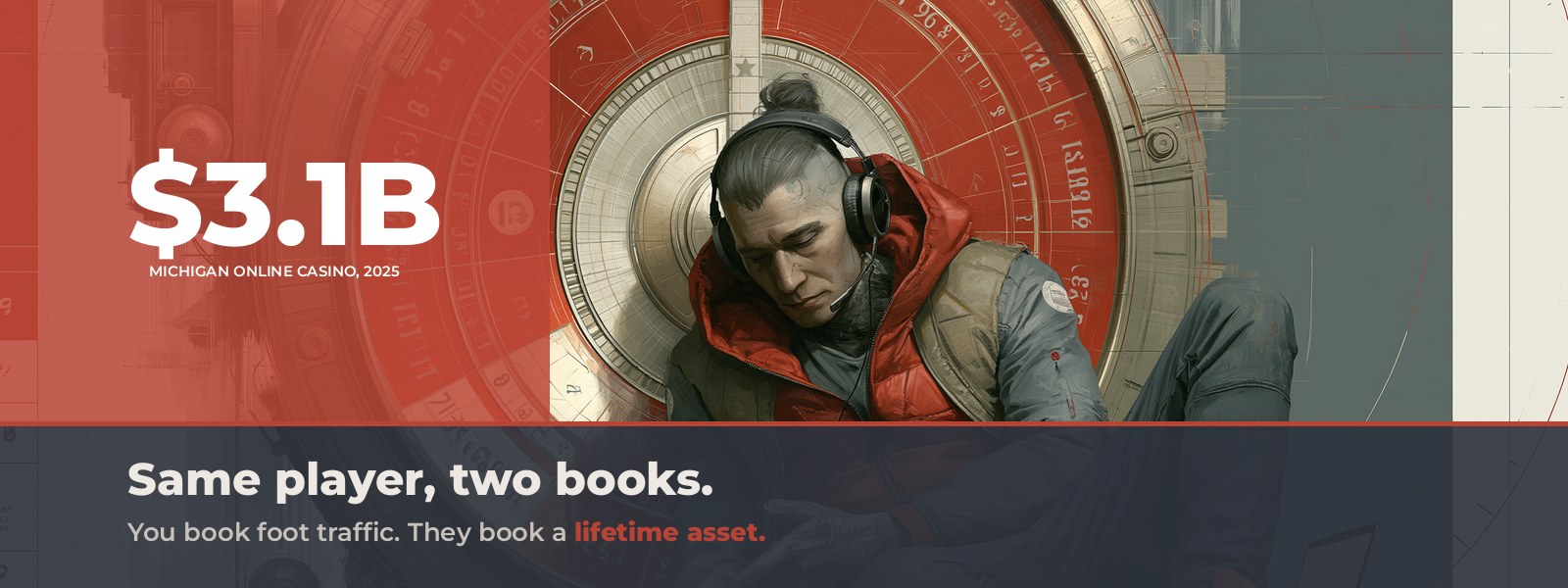
Regional and tribal operators built the brand, the loyalty file and the floor traffic the national apps pay heavily to rent. The player they already own keeps paying someone else once they get home. Michigan is the second-biggest online casino market in the US. It brought in $3.1B in 2025, up 29.5%. About 88% of that goes to five national apps: BetMGM, DraftKings, FanDuel, Caesars and Golden Nugget. Around ten local and tribal operators split what is left. Those locals have what no app can buy: a known name, their own player lists, loyalty data, VIP relationships, and people walking through the door every week. In October 2025 one Michigan tribal operator linked its floor loyalty programme so points earn and spend across both the casino and the app. A player you reach on the floor and the app is worth about a third more, and you already own them.
Prediction markets took $50B on the World Cup. Your licence is the edge they cannot buy.
Event contracts won the volume argument at record scale. The consumer-protection argument is still unclaimed. Prediction-market sites took more than $50B in bets across the World Cup opening. Kalshi handled $31B in June, about 85% on sports. Polymarket’s international site set a record $10.8B, plus $3.5B on its US site. The World Cup Winner market alone drew about $3.9B on Polymarket and $800M+ on Kalshi. Both are regulated by the CFTC and legal in all 50 states on paper. Massachusetts bans sports event contracts, and Arizona, Michigan, Nevada and California are fighting them in court.
Alberta went live with 22 of 50 brands. The 28 no-shows are the story.
Province 2 is live at a 20% rate. Twenty-eight approved brands chose to arrive after the preference forms. Alberta opened Canada’s second competitive online-gambling market on 13 July 2026. 22 sites went live at midnight out of 50 that had registered, leaving 28 approved but not launched. Day-one names included FanDuel, DraftKings, bet365, BetMGM and Caesars, against the government-run Play Alberta. Tax is 20% of net revenue. Forecasters expect about CAN$1.2B in gambling revenue this year, rising to CAN$1.64B by 2028.
Read the signal →
Caesars is running three brands in one small market. That is three times the bill.
A blank-slate market where every operator starts at zero recognition on the same day is the cleanest brand-architecture test the industry has run in years. Caesars went live in Alberta on day one, 13 July, with three brands at once: Caesars Sportsbook & Casino, Caesars Palace Online Casino and Horseshoe Online Casino. All three chase the same province of about 4.9M people, from one company, against a field of 50+ registered operators, far fewer of which launched on time.
Read the signal →
Alberta opens tomorrow with 47 operators. Where does the brand-capital land-grab actually sit?
Province 2 goes live 13 July. The projected revenue mix is casino-heavy, which decides which brands compound. Alberta activates its regulated open market on 13 July with 47 registered operators (FanDuel, DraftKings, BetMGM, Caesars, bet365, BetRivers, theScore among them). The province projects $76M Year-1 net revenue; JMP Securities analyst Jordan Bender estimates $700M+ annual at maturity, split roughly $500M iCasino / $200M sportsbook. It is a blank-slate market, no operator holds pre-existing Alberta recognition.
World Cup betting is 9× Qatar. Keeping those players is where the money is made.
US handle is tracking $2.8 to 4.3B, nine times Qatar. Handle is a flow number; the retained cohort is where value is made or lost. US sportsbooks are on track for $2.8B to $4.3B in World Cup bets across 104 matches, about 9× the ~$490M on Qatar 2022. Worldwide betting is projected above $50B (+43%). The 48-team format, legal mobile betting in 39 states and a strong home-team run are pushing volume past plan. Operators have shifted the talk from signing players up to keeping them: game-like features built to hold new bettors past the knockout rounds.
Prediction markets went mainstream. Whoever owns the word wins the category.
Exchanges borrowed legitimacy from finance and sport, and capital rotated into the rails. The durable contest is the story: market versus gambling. Prediction markets used the World Cup to go mainstream. A big exchange struck a FIFA branding deal and a knockout-stage tie-in, handed out as a free-to-play hub across 23+ US states. Sport is now the main event on both leading sites, over 80% on one and nearly all US activity on the other. Money is pouring into the plumbing too: a $75M raise alongside a CFTC licence, and a $35M fund, backed by the two biggest exchanges’ founders, aimed only at the rails underneath.
Read the signal →
Alberta’s operator list is shrinking before launch. Is brand discipline now the gate?
The cleared set thinned before the July 13 launch; an established brand sat out and another was removed over a cartoon-branding rule. The AGLC is gating entry on brand and compliance discipline. Ahead of Alberta’s 13 July open-model launch, the registry of operators cleared to go live slipped for the first time. The AGLC has formally cleared 28 operators / 40+ brands pending commercial agreements with the Alberta iGaming Corporation. DraftKings, BetMGM, FanDuel, Betway and Penn’s brands are cleared, but LeoVegas paused new Alberta signups and the AGLC removed one platform over a ban on cartoon-style branding that could appeal to minors.
Read the signal →
Betsson B2B revenue fell 43% in one quarter. What does platform dependency actually cost?

One client departure erased 40% of B2B revenue and halved EBIT margins. Selling on features alone leaves the next renewal entirely in the client’s hands. Betsson Q1 2026: group revenue €285.3M (−3% YoY); B2B revenue −43% on the departure of one major platform client. EBITDA fell from €77.7M to €50M (−36%); EBIT margin collapsed from 21.9% to 11.9% in a single quarter. B2C revenue hit a record high (+15% YoY) in the same period, and LatAm revenue grew 25% to become ∼33% of the group. The company is acquiring Rhino Entertainment Group, a signal of strategic pivot from B2B platform licensing toward B2C control.
Argentina opens two new licence windows: who locks share first?
Early brand-builders lock preference before media inflates. Two provinces opened licence applications with local-partner requirements, extending the regulated map beyond Buenos Aires province and the capital. Application windows close within 90 days, and early indications suggest 6–8 licences per province. The Buenos Aires precedent is instructive: operators who entered in the first wave now hold roughly 70% of provincial share, and media costs have more than doubled since launch.
Read the signal →
Betano defends a $10bn valuation built on just $54M raised
Scale without proportional brand architecture, now with a number attached. Kaizen Gaming announced a $10bn valuation, describing itself as a bootstrapped “decacorn”, only ~$54M raised across its history. It runs Betano and Stoiximan across roughly 20 regulated markets, having entered the UK, Colombia, Brazil and Ghana since 2024, and in March 2026 acquired AI sports-trading provider GameplAI to deepen Betano’s proprietary capability. The company remains founder-controlled.
Read the signal →