Signal archive
Operators signals
Theme: every BrandCapitalWorks iGaming signal tagged Operators. Each one carries the fact, the enterprise-value read, and the forecast. 6 signals.
Nine more companies bought a Brazilian licence this year. The bill in Congress deletes the casino.

Brazil’s regulated market grew 15% in the first half of 2026. The governing party is now backing a bill that removes online casino from it. Bill PL 2,258/2026 was tabled on 7 May by Paulo Pimenta of the governing Workers’ Party. It keeps fixed-odds sports betting legal and removes online casino games from the regulated market. At the end of July, President Lula told his ministers to back it. The government wants it through Congress before the first round of voting on 4 October. The bill sits with the Chamber of Deputies, waiting on committee assignment.
The UK doubled its gaming tax. Flutter cut $210M from guidance.

A 40% remote gaming duty is resetting the economics of the UK market, and the largest operator just put a number on the pain. The UK’s remote gaming duty rose from 21% to 40% in April 2026. On 5 August, Flutter, the owner of Paddy Power and Sky Bet, put a figure on it: a roughly $320M hit to 2026 profit before mitigation. Flutter also cut its full-year profit guidance by $210M and posted a $296M quarterly loss. The duty now takes forty pence of every pound of gross gaming revenue in its home market.
BetMGM’s casino now carries 70% of its revenue while the sportsbook sits flat.

Revenue went up and profit went down. The casino and its database did the earning, while the sportsbook took the hits from prediction markets and player-friendly results. BetMGM reported Q2 on 28 July. Net revenue rose 3% to $711M, but adjusted profit fell 14% to $74M. The split tells the story. iGaming grew 8% to $483M and is now about 70% of the business, while online sports was flat at $228M and gave back most of its retail margin to customer-friendly results.
Rush Street bet on casino over sportsbook, and the slowdown is proving it right.
While sportsbook-led operators slow down, Rush Street’s casino-first model keeps compounding. The players it keeps are worth more than the handle it chases. Rush Street Interactive built its business around online casino and player retention, and put less weight on sportsbook handle. That choice is showing. Its most recent quarter posted revenue up 41% to $370.4M and adjusted profit up 81% to $60.2M, and it raised full-year guidance while several sportsbook-led rivals were guiding down.
Read the signal →
Why do casino operators pay national apps to reach players already sitting in their own database?
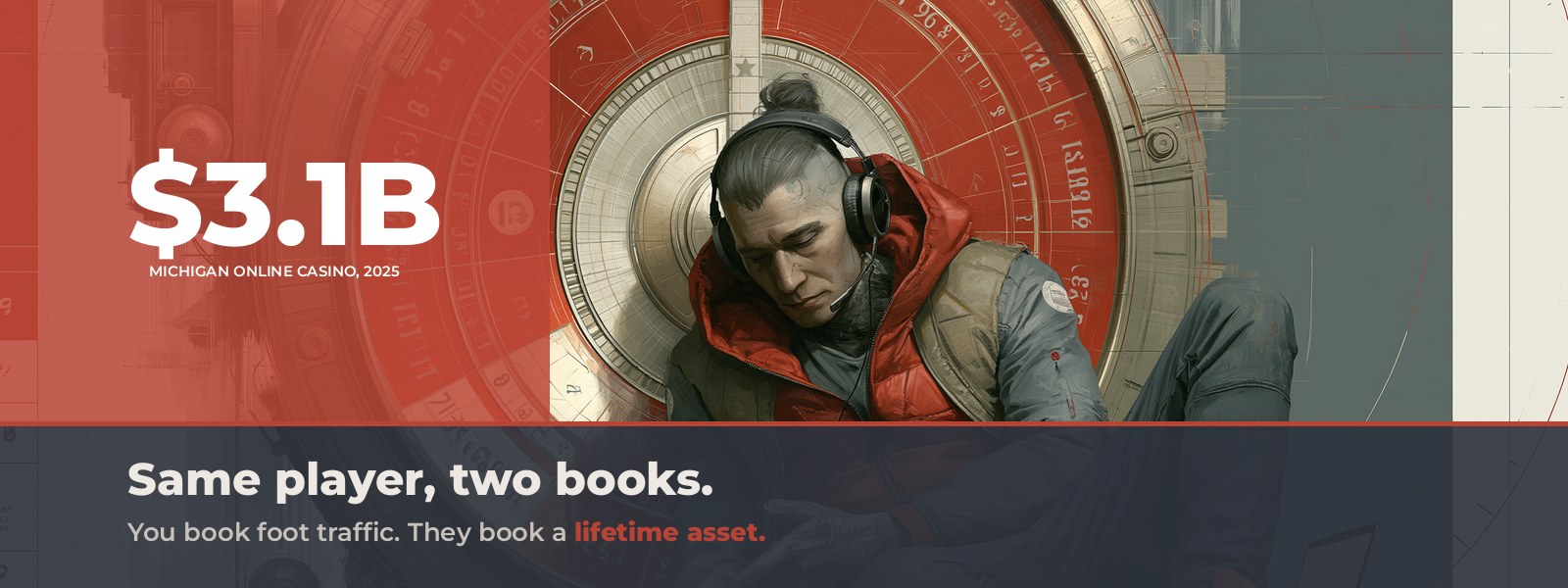
Regional and tribal operators built the brand, the loyalty file and the floor traffic the national apps pay heavily to rent. The player they already own keeps paying someone else once they get home. Michigan is the second-biggest online casino market in the US. It brought in $3.1B in 2025, up 29.5%. About 88% of that goes to five national apps: BetMGM, DraftKings, FanDuel, Caesars and Golden Nugget. Around ten local and tribal operators split what is left. Those locals have what no app can buy: a known name, their own player lists, loyalty data, VIP relationships, and people walking through the door every week. In October 2025 one Michigan tribal operator linked its floor loyalty programme so points earn and spend across both the casino and the app. A player you reach on the floor and the app is worth about a third more, and you already own them.
Caesars is running three brands in one small market. That is three times the bill.
A blank-slate market where every operator starts at zero recognition on the same day is the cleanest brand-architecture test the industry has run in years. Caesars went live in Alberta on day one, 13 July, with three brands at once: Caesars Sportsbook & Casino, Caesars Palace Online Casino and Horseshoe Online Casino. All three chase the same province of about 4.9M people, from one company, against a field of 50+ registered operators, far fewer of which launched on time.
Read the signal →
Work Together
The full intelligence layer is in the cockpit.
EVA-scored operators, real-time signals, and a private view of which brands are building durable value, available to engaged clients.